
TL;DR — The Short Answer
Wait — Satellite Internet Straight to My Phone?
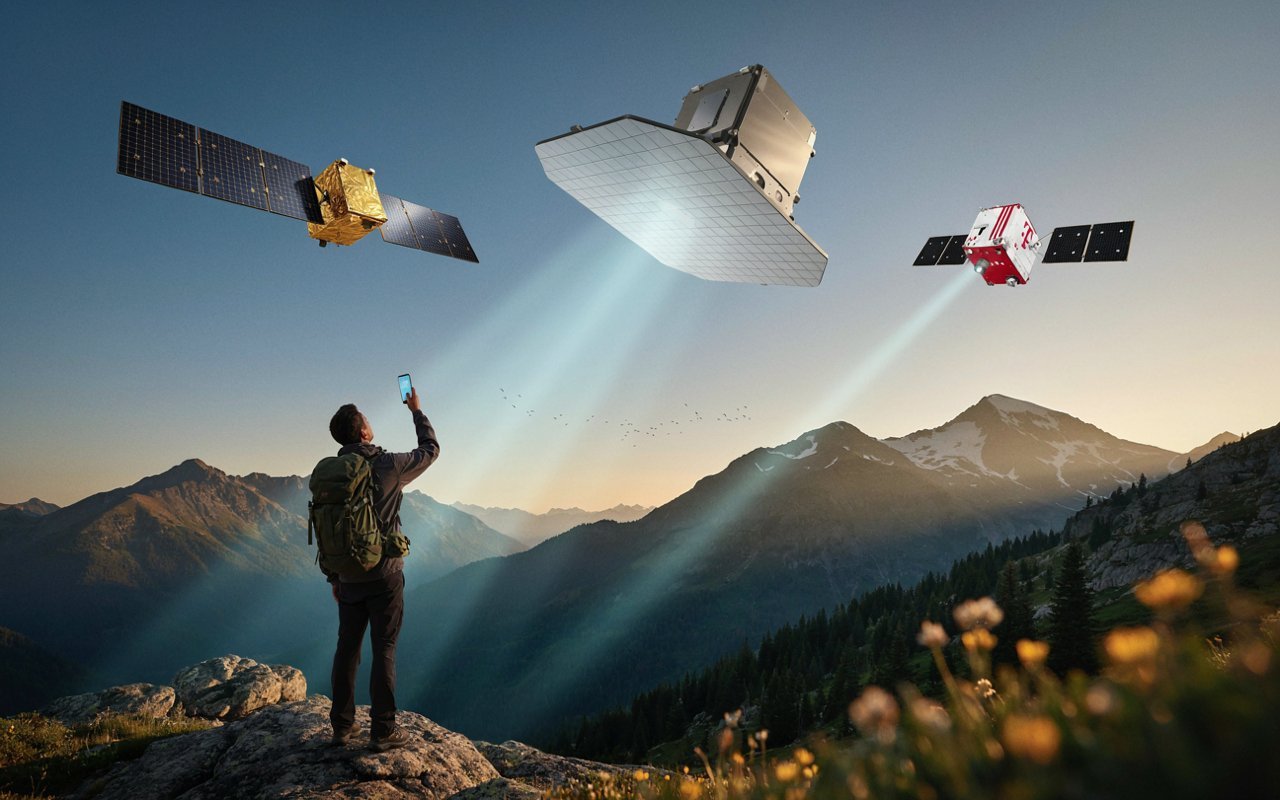
Yes, and no dish required. That’s the whole point of “direct-to-cell” (the industry calls it direct-to-device, or D2D). Companies put what’s basically a cell tower on a satellite, point it at the ground, and your regular phone connects to it like it would any tower. No special hardware, no antenna, no giant backpack radio.
The catch? A cell tower sits maybe a mile away. These satellites are 200+ miles up, moving at 17,000 mph, and your phone puts out about as much power as a nightlight. Physics wins. So what you get is real, useful connectivity — but it’s a lifeline, not a broadband pipe.
Here’s the confusing part for shoppers: the three names in this article aren’t three competing plans you can pick between at a store. They’re three different layers of the same industry. Let’s untangle that first, because it’ll save you a lot of frustration.
- Starlink (SpaceX) — builds and flies the satellites. Doesn’t sell you a phone plan directly (yet).
- T-Mobile — sells the plan. Its “T-Satellite” service runs on Starlink’s satellites.
- AST SpaceMobile — builds a rival satellite network. Doesn’t sell to consumers either. AT&T and Verizon will resell it under their own names.
The 2026 Snapshot
A few numbers that explain why the market looks so lopsided right now:
SpaceX had a roughly two-year head start, and it shows. T-Mobile’s T-Satellite went commercial on July 23, 2025, and has been quietly adding features ever since. AST SpaceMobile, meanwhile, is still assembling its constellation — it launched BlueBirds 11, 12, and 13 on August 5, 2026, bringing its total to 13 spacecraft.
That gap matters more than any spec sheet. AST’s satellites are individually far more capable (its newest array spans nearly 2,400 square feet, the largest commercial communications antenna ever unfolded in low Earth orbit), but you need enough of them overhead for the service to work continuously. With 13 birds, coverage comes and goes in windows.
What You Can Actually Buy Today
T-Satellite with Starlink
T-Mobile × SpaceX
$10
/month (or free on top plans)Texting, MMS, location sharing + 27 optimized apps
- Works on any carrier — AT&T and Verizon customers can add it via eSIM
- Included at no cost on Experience Beyond and Go5G Next plans
- Connects automatically when you lose tower signal
- Text-to-911 supported (may be delayed or unavailable)
- Roams in Canada and New Zealand
- Data only works with approved apps, not the open web
- Many popular phones get texting but not satellite data
Verizon Satellite Messaging
Verizon × Skylo
$0
/month with myPlanTwo-way texting + Satellite SOS only
- Genuinely free — no add-on charge on myPlan
- Send texts to any device, not just emergency services
- Location sharing built in
- Covers the continental U.S., Hawaii, parts of Alaska
- Very short device list (newer Galaxy and Pixel models)
- No app data at all — text only
- Uses geostationary satellites, so you need a clear southern sky
If you carry a recent iPhone or Pixel, you already have some satellite ability baked in — Emergency SOS, roadside assistance, and Messages via satellite — with no carrier plan needed. That’s a separate system from everything in this article, and it’s built for emergencies rather than everyday off-grid use.
What’s Coming Next (And When)
AT&T Satellite Service
AT&T × AST SpaceMobile
TBA
/pricing not announcedTargeting voice, data and video to normal phones
- Aiming at real broadband speeds, not just texting
- FirstNet public safety integration already in field testing
- Uses AT&T’s own 850 MHz spectrum from space
- Beta opens to a select group of customers first
- AT&T has no consumer satellite texting product live yet
- Early coverage will be intermittent, with gaps between passes
Verizon Space-Based Broadband
Verizon × AST SpaceMobile
TBA
/pricing not announcedUpgrade path beyond today’s free Skylo texting
- Runs alongside the free Skylo texting Verizon already offers
- Also uses 850 MHz low-band spectrum from orbit
- Goal is coverage across 100% of the United States
- Verizon is hedging with multiple satellite partners
- Same intermittent-coverage limitation as AT&T early on
- No word on whether it stays free or becomes paid
Take them with a grain of salt. AST originally targeted around 45 satellites in orbit by the end of 2026 — the threshold for continuous nationwide coverage — but pushed that goal to early 2027 in a July 2026 filing, citing launch vehicle availability and manufacturing logistics. Satellite timelines slip. Plan around what’s live today.
Head-to-Head Comparison
Here’s everything side by side. Note that two of these columns describe services you can’t sign up for yet — that’s the honest state of the market in August 2026.
| Feature | T-Satellite (Starlink) | AST SpaceMobile (AT&T / Verizon) | Verizon Skylo |
|---|---|---|---|
| Status | Live since July 2025 | Beta expected later 2026 | Live |
| Monthly price | $10 (free on top plans) | Not announced | $0 with myPlan |
| Satellites in orbit | 650+ | 13 | Uses existing geostationary fleet |
| Text messaging | Yes, plus picture messages | Planned | Yes |
| App data | Yes — 27 optimized apps | Planned (voice, data, video) | No |
| Voice calls | Not standard voice; WhatsApp calling works | Demonstrated in testing | No |
| Peak demonstrated speed | Low — built for light data | 98.9 Mbps on older hardware; newer array expected to far exceed 120 Mbps | Narrowband messaging only |
| Coverage pattern | Near-continuous nationwide | Intermittent — gaps between passes may run hours | Continuous where you have sky view |
| Works on other carriers | Yes — AT&T and Verizon customers welcome | No | No |
| Compatible phones | 60+ models across brands | Designed for unmodified smartphones | Short list of newer Samsung and Pixel |
| Emergency texting | Text-to-911 supported | FirstNet integration in testing | Satellite SOS included |
| International use | Canada, New Zealand roaming | Partners in 17+ countries planned | U.S. focused |
| Best for | Anyone who leaves cell coverage regularly | People who want real broadband off-grid, eventually | Verizon users who just want a safety net |
What Direct-to-Cell Actually Feels Like to Use
This is where a lot of people get disappointed, so let’s set expectations properly.
When you walk out of tower coverage with T-Satellite active, your phone doesn’t scream “NO SERVICE” anymore. It shows a network name — T-Mobile SpaceX or T-Sat+Starlink — and texts start flowing again. There’s no app to open and no button to press. It just happens.
But satellites move. Your phone may need a minute to find one, and the connection can time out and come back. Messages send, then pause, then send again. If you’ve ever used a slow hotel Wi-Fi, it’s a bit like that, except the delays are because a spacecraft went over the horizon.
The App List Is the Whole Story
Satellite data isn’t a general internet connection. Apps have to be specifically optimized for it. T-Mobile officially lists 27 satellite-ready apps, and users have found a few more working unofficially. The ones that matter most:
- WhatsApp — including voice and video chat at reduced quality
- Google Maps and Google Messages
- AllTrails for hiking routes
- AccuWeather and native weather apps
- X (formerly Twitter)
- Apple Music, Find Hub, Fitness
- Discord, Signal, and LINE (added quietly)
- Telegram
- Waze
- Snapchat
- Kik
- Regular web browsing
- Any kind of video streaming
- Email with large attachments
Before you head somewhere remote, download and sign in to every app you might need. Satellite links are too thin to handle a first-time login, an app update, or a password reset. Do that part on Wi-Fi at home.
Will Your Phone Actually Work?
This trips up more people than pricing does. With T-Satellite there are two separate compatibility lists — texting and data — and they don’t match.
Texting support is broad and reaches back several phone generations. Satellite data is much narrower. T-Mobile has publicly stated that a long list of otherwise-modern phones will not get satellite data, including the iPhone 13 through iPhone 16, the Pixel 9 series, the Galaxy S22 through S25 lines, and several Galaxy Z Fold and Flip models.
If you own one of those, you’ll still get texting and location sharing over satellite — which is the part that saves lives — but the app data feature won’t light up.
On a Samsung phone: open Settings → Connections → Satellite. If satellite is enabled on your plan, you’ll see the list of supported apps right there. On other Android phones and iPhones, you’ll need to check T-Mobile’s support page for your exact model, since there’s no universal in-phone list.
What It Costs Over Time
Satellite add-ons are cheap because they extend a phone plan rather than replace one. Here’s the three-year math on the only option you can buy today:
- $10/month × 36 months = $360
- Hardware cost: $0
- Activation fee: $0
- Works with your existing carrier
- Cancel any month in the T-Life app
- Device cost: $200–$450 upfront
- Subscription: $15–$65/month
- Three-year total: $740–$2,790
- Separate gadget to carry and charge
- Better global coverage and true SOS monitoring
For most weekend hikers, road-trippers, and rural commuters, $10/month on the phone you already carry is a much easier decision than a dedicated device. Serious backcountry travelers, boaters, and anyone going truly off-grid for days still want a proper satellite messenger with global coverage and monitored SOS. These aren’t mutually exclusive — plenty of people carry both.
Which One Should You Choose?
- Drive rural highways, hike, camp, hunt, or fish regularly
- Want app data, not just texts
- Are on AT&T or Verizon and don’t want to switch carriers
- Already pay for T-Mobile’s Experience Beyond (it’s free — go turn it on)
- Live somewhere with patchy coverage at home
- Want something that works today, not in a future press release
- Are on Verizon with a recent Galaxy or Pixel
- Only leave coverage occasionally
- Just want an emergency safety net, not off-grid productivity
- Don’t want another line item on your bill
- Are happy to wait and see what Verizon’s AST service looks like
Only if you’re curious rather than in need. AST’s technology is genuinely more ambitious — real broadband to an unmodified phone — but early beta service will be intermittent, invitation-only, and unpriced. If you need coverage in a dead zone this hunting season, waiting isn’t a strategy.
The Bigger Shake-Up Behind the Scenes
Two things happened in 2026 that will reshape this market, and they’re worth knowing about even if they don’t change what you buy this week.
The FCC approved SpaceX’s roughly $17 billion acquisition of about 65 MHz of nationwide spectrum from EchoStar. For the first time, Starlink can run direct-to-cell on frequencies it owns instead of borrowing a carrier’s.
AT&T, T-Mobile, and Verizon agreed in principle to form a joint venture pooling spectrum for a unified direct-to-device platform. Their existing satellite partnerships all continue unchanged.
BlueBirds 11, 12, and 13 reached orbit, following the June launch of 8, 9, and 10. Satellites 14 through 16 are already in launch prep.
AT&T and Verizon expect to open AST-powered beta service to select customers, with non-continuous coverage to start.
AST targets its continuous-coverage threshold in early 2027. SpaceX is developing next-generation direct-to-cell satellites promising a step change in capacity, and has floated launching a retail “Starlink Mobile” service of its own.
Read between the lines and the story is simple: three carriers who compete on everything suddenly cooperating on satellite is a response to SpaceX becoming a spectrum owner rather than just a vendor. That’s good news for you — competition here means faster feature rollouts and, eventually, pressure on pricing.
Our Verdict
In August 2026, this isn’t really a three-way race — it’s one shipping product and two promising roadmaps. T-Satellite is the pick, and the fact that it works on any carrier makes it an easy $10 to justify if you spend any real time outside tower coverage.
Verizon customers with a compatible Galaxy or Pixel should absolutely turn on the free Skylo texting today — there’s no reason not to. Whether you also want T-Satellite comes down to one question: do you need more than texts?
AST SpaceMobile is the one to watch, not the one to wait for. When it delivers continuous coverage with genuine broadband speeds, it will make everything described here look primitive. That’s a 2027 conversation, not a 2026 purchase.
Frequently Asked Questions
No. Direct-to-cell is designed to fill dead zones with light data — texts, location pins, weather, mapping, and messaging apps. It can’t handle streaming, video calls at normal quality, downloads, or general web browsing. If you want satellite home internet, that’s standard Starlink with a dish, which is an entirely different product at an entirely different price.
No, and this is the most underrated thing about the service. AT&T and Verizon customers can add T-Satellite for $10/month and keep their existing plan. It works through a second eSIM profile on your phone, so your regular number and carrier stay exactly as they are. Your phone just uses the T-Satellite profile when there’s no other signal.
Generally no. You need to be outdoors with a clear view of the sky. A roof, dense tree canopy, or a deep canyon will block the signal. Sitting in a car with the windows up usually doesn’t work either. Step outside, hold the phone naturally, and give it a minute to find a satellite passing overhead.
T-Satellite’s current generation is deliberately slow — T-Mobile describes it as built for what matters off-grid, not high-speed data. AST SpaceMobile has demonstrated peak speeds of 98.9 Mbps in testing using older hardware, and its newest satellite is expected to greatly exceed 120 Mbps. But peak lab speeds and what you’d get in the field with 13 satellites overhead are very different numbers.
You can text 911 on T-Satellite, and Verizon’s Skylo service includes Satellite SOS. Both carriers warn that satellite emergency service may be delayed, limited, or unavailable depending on conditions. Treat it as a valuable backup, not a guarantee. If you’re heading somewhere genuinely remote, a dedicated satellite messenger with monitored SOS is still the safer tool.
Satellite data requires deeper modem and software integration than SMS does, and it has to be certified per device. T-Mobile has confirmed a long list of otherwise-current phones — including iPhone 13 through 16, Pixel 9 series, and Galaxy S22 through S25 — that will get satellite texting but not satellite data. It’s a hardware and certification limitation, not something a software update is likely to fix.
Yes, on myPlan there’s no additional charge for Satellite SOS or satellite messaging through Skylo. The real cost is the phone: the feature only works on a narrow set of newer devices, currently the Galaxy S25 and S26 series, Galaxy Z Fold 7, Z Flip 7, and recent Pixels. If your phone isn’t on the list, no plan upgrade will unlock it.