
TL;DR — The Short Answer
Why Bundling Finally Makes Sense in 2026
For years, “bundle and save” meant adding a cable TV package you didn’t want. That’s over. In 2026 the big three cable and fiber companies are all pushing the same thing instead: home internet plus a phone line, on one bill, for one price.
The reason is simple. Comcast, Charter and Verizon are all fighting to keep customers from switching. Bundling makes leaving harder and cheaper to prevent. That competition is good news for you — the first-year deals right now are the most aggressive they’ve ever been.
But the three offers are built very differently. One is a true single-price plan. One is a promo stack that resets after a year. One locks half your bill for five years and the other half for one. Knowing which is which is the whole game.
Head-to-Head Comparison
Here’s every detail that actually changes what you pay. Read the “after promo” row carefully — that’s where most people get caught.
Xfinity vs Spectrum One vs Verizon One — Full Breakdown
| What matters | Xfinity Internet + Mobile | Spectrum One | Verizon One |
|---|---|---|---|
| Advertised start price | $40/mo (300 Mbps) | $40/mo (100 Mbps) Tie | $70/mo all-in |
| Taxes & fees | Extra | Extra on internet; mobile taxes included | Included in price Winner |
| Free mobile line | 1 line free for 12 months | 1 line free for 12 months | Line built into the $70 Simplest |
| Extra line price | $30 (Select) / $45 (Plus) | $30 Unlimited Winner | $30 per line |
| Internet price stability | Locked 5 years Winner | 12-month promo, then market rate | Single ongoing price |
| Wireless network used | Verizon + 23M+ WiFi hotspots | Verizon + 25M+ WiFi hotspots | Verizon, direct Winner |
| Premium data per line | 50 GB (Select), unlimited (Plus) | Unlimited, slowed after 30 GB | Unlimited talk, text & data |
| Router / equipment | Included with plan | Advanced WiFi $10/mo (free on Gig+) | Router + install included Winner |
| Top speed available | Up to 2 Gbps | Up to 7 Gbps in select areas Winner | Fios 500 Mbps base, upgrades from +$15 |
| Contract | None Tie | None Tie | None Tie |
| Who can sign up | New internet customers get best rate | New and existing customers | New Verizon customers only |
| Activation fee | $25/line (often waived in promos) | $30 one-time internet activation | Waived Winner |
| Best for | Long-term price certainty | Households with 3–5 lines | People who want one simple bill |
The Three Bundles, Explained Properly
Below is what each provider is actually selling, with the real published price and the real phone number for their sales team. Numbers change often, so always confirm at your own address before you sign anything.
Xfinity Internet + Mobile
300 Mbps + Mobile Select line
$40
/monthInternet rate held 5 years. Mobile line free for the first 12 months. Autopay and paperless billing required.
- Unlimited data, no contract
- Equipment included in the price
- Mobile Select: 50 GB premium data + 15 GB hotspot
- Mobile Plus at $45/line adds 4K streaming, 50 GB hotspot and lifetime device protection
- No multi-line discount — every line is flat rate
- Taxes and fees are extra
Spectrum One
Internet + Advanced WiFi + Unlimited Mobile
$40
/monthStarting price for 100 Mbps with WiFi and one mobile line. Faster tiers cost more; Gig plans include Advanced WiFi free.
- First Unlimited line free for 12 months
- Extra lines $30 each — the cheapest of the three
- No data caps, no contracts
- Speeds up to 7 Gbps in select markets
- Unlimited plan slows after 30 GB per line
- Internet price jumps to market rate after month 12
Verizon One
Home internet + one Simplicity line
$70
/monthAfter autopay. Taxes, fees and equipment are all included — this is close to your real monthly cost.
- Fios 500 Mbps, 5G Home Plus, or Home Internet Lite Extra depending on your address
- Router and professional installation included
- Activation and upgrade fees waived
- 3% back monthly in Verizon Dollars
- Speed upgrades from +$15/mo where available
- New Verizon customers only
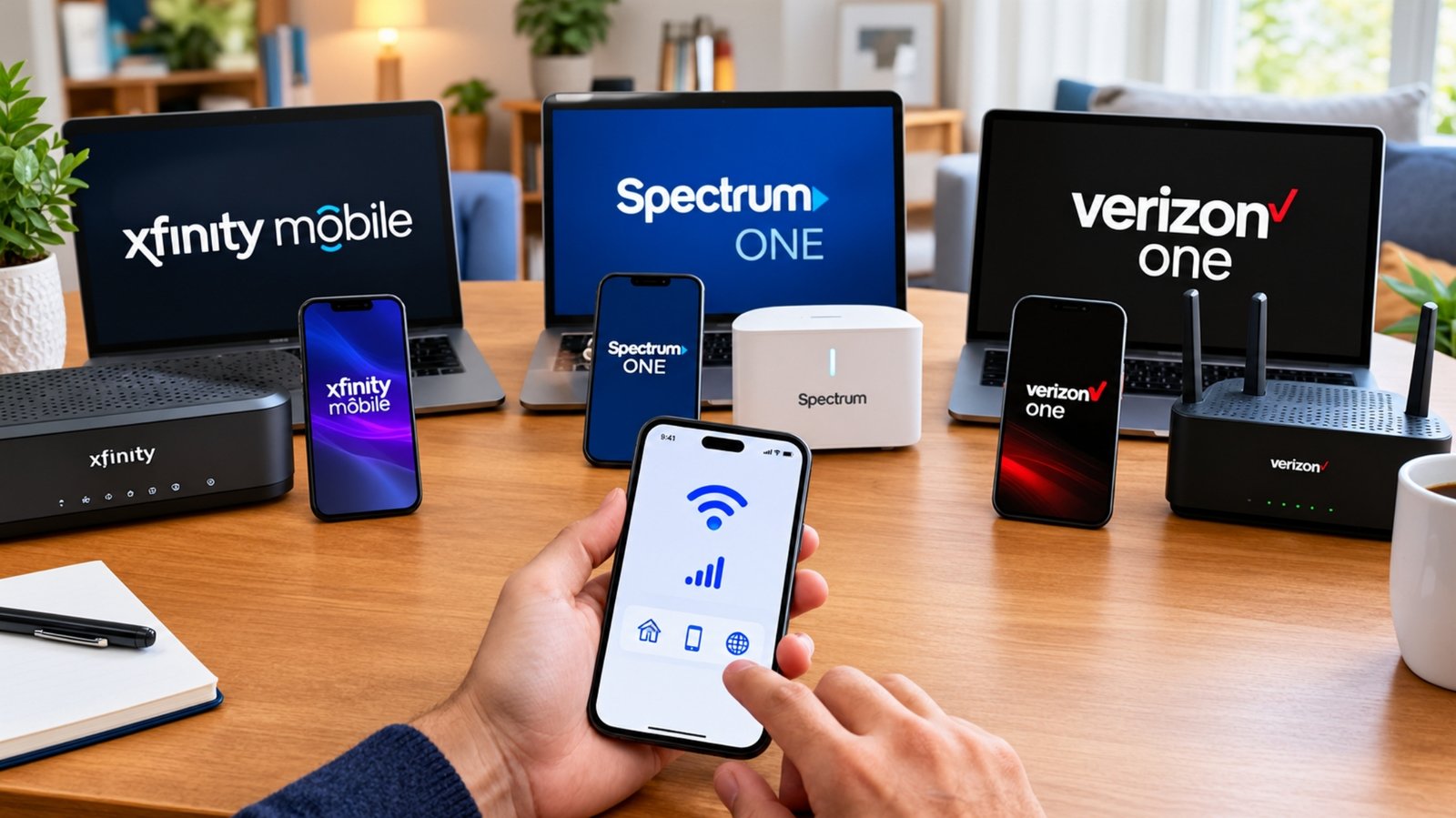
Xfinity Mobile and Spectrum Mobile are both MVNOs — they rent capacity on Verizon’s 4G LTE and 5G network. Verizon One is Verizon. So if someone tells you one of these has better coverage than the others, be skeptical. Where they genuinely differ is data priority during congestion, hotspot allowance, and how fast your bill grows in year two.
What You’ll Really Pay: Two-Year Math
Advertised prices are year-one prices. Here’s what a single person with one phone line pays over 24 months, using each provider’s own published rates. Taxes are estimated where the provider doesn’t include them.
Xfinity — 300 Mbps + 1 line
Spectrum One — 100 Mbps + 1 line
Verizon One — internet + 1 line
The gap is smaller than the headline prices suggest. Xfinity wins on raw cost for one line, but only by about $200 over two years — and only if your address qualifies for the $40 five-year rate. Verizon One costs the most, and gives you the least billing anxiety. That trade is worth real money to some people.
The picture flips fast for families. Spectrum One with four lines is roughly $130/mo in year one ($40 bundle plus three lines at $30). Xfinity is about $130/mo too, but every line stays $30 forever with no family discount. Verizon One with four lines is $160/mo — except that figure already includes taxes, which adds $15–$30 to the other two. At four lines, the three are effectively tied.
Where Each One Actually Wins
Xfinity: pick it for the five-year internet lock
Xfinity’s real advantage isn’t the free mobile line — everybody offers that now. It’s that the internet half of your bill is locked for five years. That’s unusual for cable, which historically raises prices every 12 months like clockwork.
Comcast rebuilt its wireless lineup in April 2026 around two flat plans: Mobile Select at $30 a line and Mobile Plus at $45 a line. Mobile Plus is genuinely interesting — it includes lifetime device protection and anytime phone upgrades with no trade-in inspection, which are things other carriers charge $10–$18/mo for separately.
The trade-off: Comcast removed multi-line discounts. Four lines cost exactly four times one line. If you have a big family, do the math before you assume Xfinity is cheapest.
Spectrum One: pick it if you need three or more lines
Spectrum One folds internet, its Advanced WiFi router service, and one Unlimited mobile line into a single plan. Additional lines run $30 each, or $40 for Unlimited Plus and $50 for Unlimited Plus Premium. Charter also backs the offer with a savings guarantee for switchers.
Two things to watch. First, Spectrum’s “Unlimited” base plan reduces speeds after 30 GB in a billing cycle — fine for most people, annoying for heavy users. Second, the $10/mo Advanced WiFi fee only disappears if you take a Gig plan or faster. On the cheaper tiers it’s a real line item.
Verizon One: pick it if you’re done with billing surprises
Verizon One is the most honest pricing on this page, and that’s not a compliment I hand out often. $70 a month includes the taxes, the fees, the router and the installation. When your first bill arrives, it says $70. No other bundle here can promise that.
You get one of three internet products depending on what’s built at your address: Fios 500 Mbps, 5G Home Plus, or Home Internet Lite Extra. That last one is meaningfully slower, so check what you’d actually receive before you commit. Speed upgrades start at $15/mo for Fios and 5G Home customers.
The hard limit: Verizon One is for new customers only, and it can’t be stacked with Verizon’s separate Mobile + Home Discount. If you’re already a Verizon phone customer, you’re looking at that other path instead — $15/mo off home internet plus a perk credit, which is a different deal with different math.
Honest Pros and Cons of Bundling At All
What bundling gets right
- One bill, one login, one support number
- The free-line promos are real money — $360 or more in year one
- Cable MVNOs let phones offload to home WiFi, cutting cellular usage
- No contracts on any of the three, so leaving is cheap
- Equipment fees often disappear inside the bundle price
- Switching one service later is easier than switching two
What bundling costs you
- Your phone service dies if you cancel the internet — they’re linked
- Year-two price jumps are steep and rarely explained upfront
- Cable mobile plans deprioritize your data during congestion
- You lose the ability to shop each service on its own merits
- Promo credits can vanish if you change any part of the plan
- Bad customer service on one product now affects both
Set a calendar reminder for month 11. Every one of these deals converts to full price silently at month 12. If you call before the promo ends and say you’re comparing offers, retention teams frequently extend the discount or move you to a cheaper tier. It costs you ten minutes and often saves $300 a year.
How to Choose in Under Five Minutes
Our Verdict
For most single-line households, Xfinity’s internet + mobile bundle is the best value — the five-year internet lock is a genuine differentiator, and $40/mo for 300 Mbps with a free phone line is hard to beat on price.
For families with three or more phones, Spectrum One is the cheapest path, since $30 lines add up more slowly than anywhere else and Spectrum doesn’t cap your data at home.
For anyone who’s been burned by a surprise bill, Verizon One is worth the extra money. Paying $70 that stays $70 — taxes, router, install and all — removes a whole category of stress. It’s the only offer here where the advertised number is the number you pay.
Whichever you choose, check availability at your exact address first. All three of these prices assume you qualify for the best tier in your area, and coverage maps lie more often than they should.
Frequently Asked Questions
Yes, for Xfinity and Spectrum. Both require an active home internet account to have mobile service at all — Xfinity Mobile plans require Xfinity Internet, and Spectrum Mobile is only sold to Spectrum internet customers. Cancel the internet and the phone plan goes with it. Xfinity also applies a surcharge if you drop the internet portion. Verizon One is a single plan too, so the same logic applies there.
Mostly. You’ll still pay taxes and fees on the line, and an activation fee may apply — Xfinity charges $25 per line unless it’s waived by a promotion, and Spectrum charges a one-time internet activation fee. The service charge itself genuinely is $0 for 12 months. Just remember it appears as a monthly credit, not a discount built into the plan, so the credit stopping is what raises your bill at month 13.
They’re nearly identical, because Xfinity Mobile and Spectrum Mobile both run on Verizon’s network. The difference is data priority. As MVNO customers, Xfinity and Spectrum users can be deprioritized behind Verizon’s own postpaid customers when a tower is congested — a stadium, a rush-hour highway, a festival. In everyday use most people never notice. If you’re regularly in packed places, Verizon One’s direct service has an edge.
It uses read-only access to your bank data and only adds positive payment history — it will never add a missed payment. That means there’s no scenario where using it lowers your score. The real limitation isn’t safety, it’s reach: nothing it adds shows up on your Equifax or TransUnion report.
With Xfinity, the mobile line goes from $0 to $30 a month, but the internet price stays locked. Expect roughly a $30 increase. With Spectrum One, both the mobile credit and the internet promo expire at the same time, plus the $10 Advanced WiFi fee kicks in on lower tiers — that combination can add $50 or more. Verizon One is designed to avoid this cliff entirely, which is a large part of why it starts higher.
Yes, all three support bring-your-own-device as long as the phone is unlocked and compatible with Verizon’s network bands. Most iPhones from recent years and most flagship Android phones work fine. Xfinity currently keeps the free-line offer available for BYOD customers, and Verizon One waives activation fees when you bring your own phone. Check the IMEI compatibility tool on each provider’s site before switching — it takes 30 seconds and prevents a genuinely painful problem.
Your number is yours by law and can be ported to another carrier. Don’t cancel the old service before the port completes — start the port from the new carrier, using your account number and transfer PIN from the old one. If you cancel first, the number is released and recovering it is difficult. None of these three bundles has a contract, so there’s no early termination fee, but you may still owe the balance on any phone you financed through them.
No. Verizon One is limited to new customers, and it can’t be combined with the separate Mobile + Home Discount or applied to lines added later to an account that already has Verizon One. If you’re an existing Verizon phone customer, the Mobile + Home Discount is the route available to you — it takes $15/mo off eligible home internet and adds a monthly perk credit toward a streaming subscription.
None of the three caps your home internet data on the plans discussed here. Spectrum has never used caps. Xfinity includes unlimited data with the bundles in this guide. Verizon Fios and 5G Home don’t cap either. The limits worth watching are on the mobile side — Spectrum’s Unlimited plan slows after 30 GB, and Xfinity’s Mobile Select can slow after 50 GB during congestion.
Bundle if the free-line promo saves you more than a cheap prepaid carrier would. A good prepaid plan runs $25–$35 a month with no strings, so a “free” line is only a win if you’d otherwise pay a major carrier $50–$80. Keep things separate if you move often, if you want the freedom to switch either service independently, or if you’re on a family plan with someone outside your household. Bundles reward stability and punish flexibility.
Last updated September 2026. Prices, promotional terms, speeds and availability change frequently and vary by address. Figures shown are the providers’ own published rates at the time of writing and exclude taxes and fees unless stated otherwise. Two-year cost estimates are illustrations, not quotes. Always confirm current pricing directly with the provider before signing up. FreeISPInfo is not affiliated with Comcast, Charter or Verizon — we’re just here to help you compare honestly.