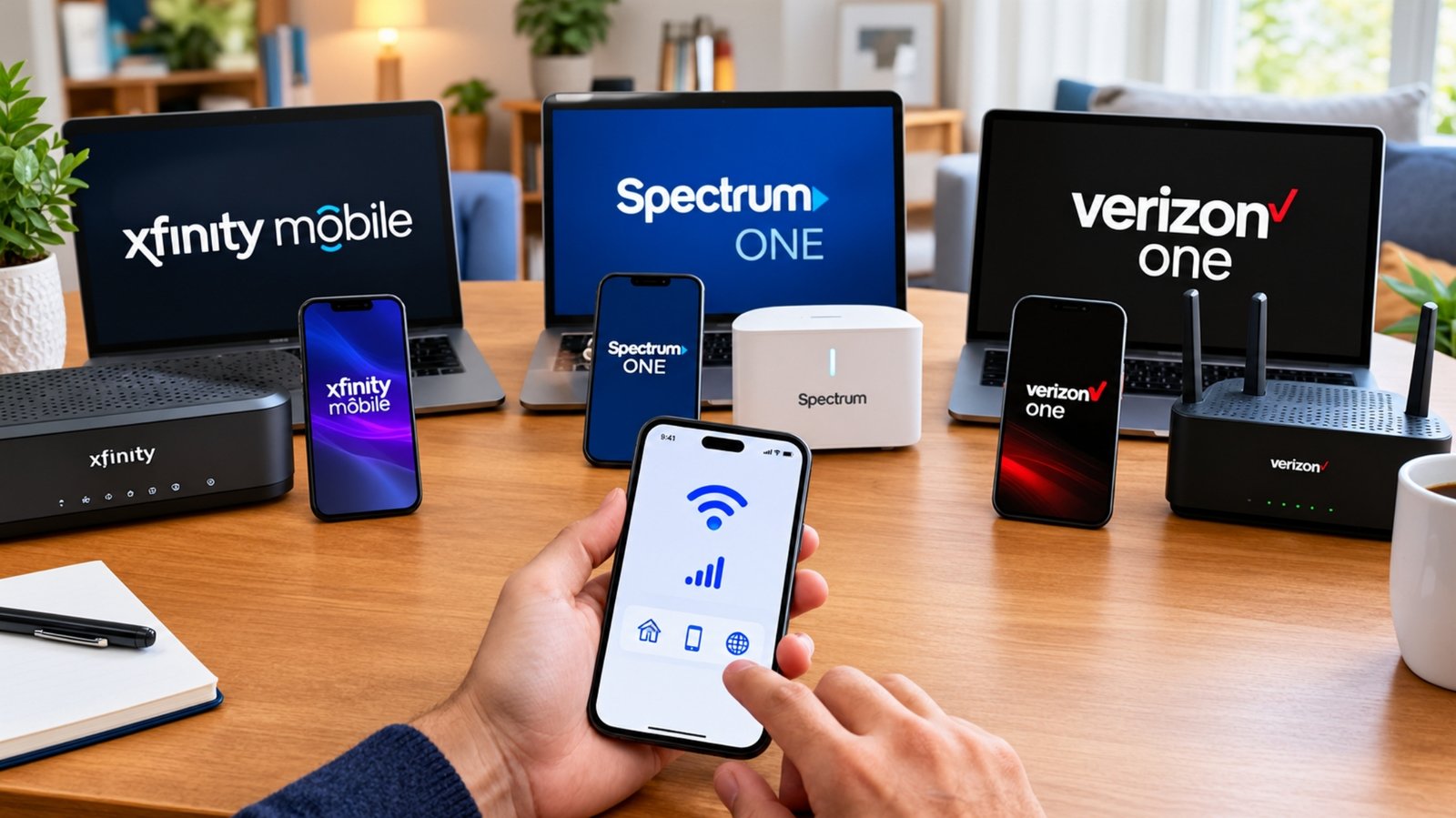


You wanted internet. You ended up with cable channels nobody watches and a phone line nobody answers. Sound familiar? For years, signing up for home internet meant getting talked into a “combo meal” — TV and a landline tacked on whether you needed them or not. The good news in 2026: you don’t have to play that game anymore. Every major provider now sells standalone, internet-only plans, and they’re often the cheapest, cleanest way to get online.
This guide breaks down the best internet-only plans you can actually buy without a forced bundle — real prices, real speeds, and the fine print that providers would rather you skim past.
TL;DR — Quick Answer
What “standalone internet” actually means
A standalone (or “internet-only”) plan is exactly what it sounds like: you pay for the internet connection by itself. No cable TV package. No traditional landline. No services you’ll never plug in. Think of it as ordering the main dish à la carte instead of being forced into the combo meal.
This matters because the way we use our homes has changed. Most households today act like mini-networks — someone’s on a work call, someone’s streaming, a kid’s downloading a game update, and a security camera is uploading clips in the background. A box of 200 cable channels and a dial tone don’t do anything for that. A solid, dedicated connection does.
Bundling can save money in specific cases — but it’s almost always a discount on a service you have to pay for, not free value. If you already stream (Netflix, YouTube TV, Hulu) and use a cell phone, a TV/phone bundle usually just adds cost. Run the math both ways before you say yes.
Best standalone internet-only plans for 2026
These are the six providers most likely to be available at your address, ranked by value for an internet-only household. Prices below are the standalone (no-bundle) starting rates verified for June 2026. Availability and promo pricing vary by ZIP code.
Spectrum Internet
Best overall value
$30
/month300 Mbps
- No data caps, ever
- No annual contract
- Free internet modem included
- Sold internet-only — TV is fully optional
- Widespread cable coverage
AT&T Fiber
Best fiber value
$34
/month100–300 Mbps
- Symmetrical upload & download
- No equipment fee on fiber
- No annual contract
- Free McAfee security included
- Internet-only, no TV required
T-Mobile 5G Home
Easiest setup
$50
/month100–400 Mbps
- Plug-and-play, no technician
- Unlimited data, no caps
- No contracts or hidden fees
- Price-lock guarantee
- $15 off if you add T-Mobile phone
Verizon Fios
Most reliable fiber
$50
/month300 Mbps
- Fiber-optic reliability
- Unlimited data included
- Router included free
- No annual contract
- Multi-year price-lock options
Xfinity
Widest availability
$35
/month150–300 Mbps
- Internet-only plans available
- 5-year price-lock options
- $10/mo off with AutoPay
- Access to Xfinity WiFi hotspots
- Heads-up: $14/mo gateway rental
Cox
Simple no-bundle plans
$50
/month300 Mbps
- Easy self-install option
- No annual contract
- Internet-only, TV optional
- WiFi equipment available
- Mobile bundle savings (optional)
Not sure who serves your address?
Call 855-696-0156
Standalone plan comparison at a glance
| Provider | Starting Price | Speed | Contract | Best For |
|---|---|---|---|---|
| Spectrum | $30/mo | 300 Mbps | None | Best all-round value, no caps |
| AT&T Fiber | $34/mo | 100–300 Mbps | None | Symmetrical fiber, no equip fee |
| T-Mobile 5G Home | $50/mo | 100–400 Mbps | None | Easiest setup, renters & movers |
| Verizon Fios | $50/mo | 300 Mbps | None | Most reliable fiber (Northeast) |
| Xfinity | $35/mo | 150–300 Mbps | Optional | Widest coverage, watch equip fee |
| Cox | $50/mo | 300 Mbps | None | Simple plans, easy self-install |
How much speed do you actually need?
Don’t let a sales rep upsell you to gigabit “just in case.” For most internet-only homes, somewhere between 100 and 300 Mbps is the sweet spot. Here’s a realistic breakdown:
| Household | Recommended Speed | What it handles |
|---|---|---|
| 1–2 people, light use | 100 Mbps | Browsing, HD streaming, video calls |
| Small family / roommates | 300 Mbps | Multiple streams + work-from-home |
| Heavy streamers & gamers | 500 Mbps | 4K streaming, big downloads, online gaming |
| Power users / large homes | 1 Gig+ | Frequent large transfers, many devices |
Most households are perfectly happy on a 300 Mbps plan and won’t notice the difference between 300 and 1,000 Mbps for everyday use. Pay for gigabit only if you regularly move huge files or have a very busy, device-heavy home.
What to watch for when going internet-only
Equipment rental fees
This is the sneakiest line item. A modem/router rental typically runs $10–$15/mo — that’s up to $180 a year on top of your advertised price. AT&T Fiber and T-Mobile include equipment free; Xfinity charges $14/mo for its gateway. If your provider lets you bring your own router, buying one can pay for itself in under a year.
The 12-month promo cliff
That tempting intro rate often jumps $20–$30/mo after a year. Set a calendar reminder for month 11, then call the retention department and negotiate or switch. With no-contract plans, you’re never locked in.
The “bundle to save” pitch
You’ll be offered a discount to add TV or a phone line. Sometimes it’s genuinely cheaper — but only if you’d use those services anyway. If you stream and use a cell phone, the bundle usually just inflates your bill. Politely decline and stick with internet-only.
Self-install vs. pro install
Most standalone plans now offer free self-installation. T-Mobile 5G Home is truly plug-and-play. If you’re not comfortable, professional install usually runs $50–$100 — sometimes waivable if you ask.
Money-saving tips for internet-only households
Turn on AutoPay. Many providers (Xfinity, AT&T) shave $5–$10/mo off for automatic payments — and you’ll never miss a due date.
Buy your own router. A solid router pays for itself versus a year of rental fees, as long as your provider allows it.
Ask about price locks. Optimum, Verizon, and Xfinity all offer multi-year price guarantees right now — lock in before the promo expires.
Call retention, not customer service. When your promo ends, the loyalty/retention team has real authority to discount. Mention you’re shopping competitors.
Consider 5G home internet. If fiber isn’t on your street, T-Mobile or Verizon 5G home internet is often cheaper than cable, needs no installer, and has no data caps.
Frequently Asked Questions
Yes. As of 2026, every major provider — Spectrum, AT&T, Xfinity, Cox, T-Mobile, and Verizon — sells standalone internet-only plans. You’re never required to add cable TV or a landline. Bundles are offered as optional discounts, not requirements, so you can decline and keep just the internet.
For most people, yes. A bundle only saves money if you’d actually use the TV or phone service. If you already stream and use a cell phone, a bundle simply adds the cost of services you don’t need. Standalone plans like Spectrum’s $30 tier or AT&T Fiber’s $34 tier are usually the cheapest path to a solid connection.
Spectrum’s 300 Mbps internet-only plan around $30/mo is our top pick for value — no data caps, no contract, and a free modem. If fiber is available at your address, AT&T Fiber at $34/mo edges it out on reliability and symmetrical speeds. For the easiest setup, T-Mobile 5G Home is hard to beat.
For one or two people, 100 Mbps is plenty for streaming and video calls. A small family or shared household is comfortable on 300 Mbps. You only really need 500 Mbps or gigabit if you have many devices going at once or regularly transfer large files. Most homes won’t notice a difference above 300 Mbps.
The most common is equipment rental — roughly $10–$15/mo for a modem/router. AT&T Fiber and T-Mobile include equipment free, while Xfinity charges about $14/mo. Watch also for promo pricing that increases after 12 months and one-time installation fees. Always ask for the total monthly cost, including all fees, before signing up.
Almost never anymore. Spectrum, AT&T, T-Mobile, Verizon, and Cox all offer no-contract internet-only service. Month-to-month flexibility means you can switch providers or renegotiate whenever a better deal shows up — which is exactly what you want when promo rates expire.
If fiber (AT&T, Verizon Fios) is available, it’s the gold standard — fastest, most reliable, with symmetrical speeds and low latency. If fiber isn’t on your street, 5G home internet from T-Mobile or Verizon is an excellent alternative: cheaper than cable, no installer needed, and no data caps. The main catch with 5G is that speeds can vary based on your distance from the tower.
Last updated June 2026. All prices, speeds, and availability are subject to change and vary by address. Advertised rates often reflect promotional pricing, AutoPay discounts, and may exclude equipment fees and taxes. Please verify current standalone (internet-only) offers directly with each provider before signing up. This guide is for informational purposes only and does not constitute financial advice.