

TL;DR — The Short Answer
The Uncomfortable Truth About Internet Bills and Credit
You’ve paid your internet bill on time for six years straight. Never missed, never late, autopay running quietly in the background. Logically, that should count for something when a lender looks at you.
It doesn’t. Not by itself.
Internet service in the U.S. is what credit people call a negative-only tradeline. Your provider has no incentive to tell Experian, Equifax, or TransUnion that you paid — but they absolutely will tell them when you didn’t. Comcast Xfinity, Spectrum, and the big telecom carriers all pass overdue balances to the bureaus, typically once an account sits 60 days past due, and collections accounts go over regardless.
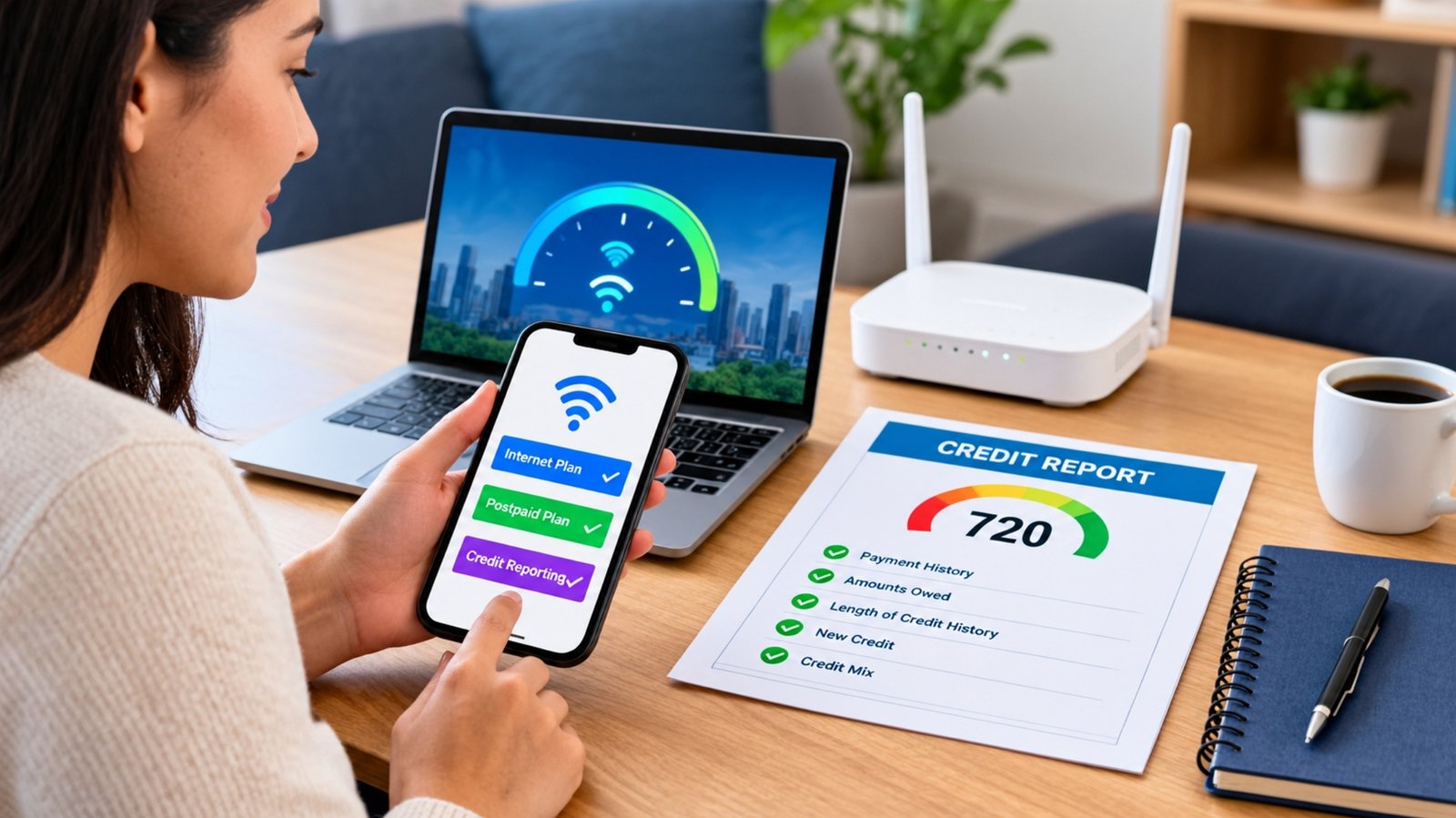
So the plan you choose doesn’t change your score on its own. What changes your score is whether you route that same bill through something that reports the good months too. That’s the real comparison in this guide: the postpaid account you already have versus the credit-reporting layer you can bolt onto it.
What Postpaid Internet Actually Does to Your Credit
Postpaid just means you get the service first and pay for it at the end of the month. Because the provider is fronting you a month of service, they want to know you’re good for it — so they check your credit at signup.
The big cable and fiber names — Xfinity, Spectrum, AT&T, Verizon, Cox — generally run a check when you order. Most use a soft inquiry, which doesn’t cost you points but can still show up on your report. Some run a hard inquiry, which shaves a few points and sits on your file for about two years. If you’re in the middle of a mortgage or auto loan application, ask which one they use before you place the order.
Here’s the part people get wrong: a weak score almost never gets you rejected. Internet companies want your business. What a thin or damaged file usually triggers is a refundable deposit — commonly in the $50–$200 range, returned after roughly 12 months of on-time payments, though AT&T’s deposits can run higher depending on your history and plan.
Pay that bill perfectly for five years and your credit file will show nothing. Miss it for two months and it shows a delinquency that can sit there for seven years. That asymmetry is exactly why bill-reporting services exist.
How and when your ISP reports you
Reporting isn’t instant. Most providers wait until an account crosses an internal risk threshold — usually 30 days past due at the earliest, with the odds climbing sharply at 60 days. Once a balance is handed to a third-party collection agency, it goes on your report no matter the day count. Unpaid equipment lease balances get treated the same way as service charges.
Practical takeaway: if you’re going to be late, being late by a few days is a billing problem. Being late by a month is a credit problem. Call the billing desk before the 30-day mark and ask for a payment arrangement — providers routinely grant them, and an account under an arrangement doesn’t get flagged.
Postpaid vs. Credit-Reporting Utilities: Head-to-Head
Below is the honest side-by-side. “Credit-reporting utility” here means a third-party service that verifies bills you already pay and furnishes them to a bureau as positive tradeline data.
How each approach affects your credit file
| Factor | Postpaid internet alone | Postpaid + credit-reporting service | Prepaid internet |
|---|---|---|---|
| Credit check at signup | Yes — usually soft, sometimes hard | Yes (from the ISP side) | None Safest |
| Deposit risk | $50–$200 typical if file is thin | $50–$200 typical | $0 Winner |
| On-time payments reported | No | Yes Winner | No |
| Late payments reported | Yes, after 30–60 days | Yes — and some tools add their own negatives | No Winner |
| Bureaus reached | All three (negatives only) | One or two, depending on tool | None |
| Backdated history | Not applicable | Up to 24 months on most tools Winner | Not applicable |
| Monthly cost of the credit benefit | $0 (no benefit either) | $0–$14.95 depending on tool | $0 |
| Typical score movement | None | Roughly 8–15 points average; more on thin files | None |
| Time to first effect | — | Minutes (Boost) to ~30 days Varies | — |
| Downside risk | Delinquency marks only | Paid tools can report misses too Watch | Service just pauses |
| Best for | People with established credit who just want service | Thin files, rebuilders, first-time borrowers | Anyone mid-loan-application or credit-averse |
How Credit-Reporting Utility Services Work
The mechanism is simpler than the marketing makes it sound. You give the service read-only access to the bank account or the provider login you use to pay your internet bill. It scans for recurring, successful payments to a recognized payee. Then it furnishes those payments to a credit bureau as a tradeline — a line item on your report showing an account and a payment history.
That matters because payment history is 35% of a FICO score, the single largest factor. If your file only has one credit card on it, adding two years of verified internet and phone payments genuinely thickens it.
Three limits worth knowing before you sign up for anything:
- Bureau coverage is fragmented. Nothing covers all three consumer bureaus for utility data. Mortgage lenders pull all three and use the middle score, so a bump on one bureau may not reach the number that decides your rate.
- Not every payment qualifies. Experian’s own Boost eligibility disclosure requires generally three or more eligible payments to a qualifying payee within six months, with at least one in the last three months. Payments made by paper check or peer-to-peer app don’t count.
- Some tools report the bad months too. Boost is positive-only by design. eCredable Lift furnishes both positive and negative history, so only link accounts you’re confident about.
None of these services is a loan and none of them checks your credit to sign up. You’re not opening a new account — you’re making an existing payment visible. That’s why there’s no hard inquiry and no new debt attached to any of them.
Credit-Reporting Tools Compared (2026)
Experian Boost
Experian only · positive-only
Free
/forever- Adds internet, phone, utility, streaming and some rent payments
- Scans up to 24 months of bank history
- FICO 8 updates within minutes
- Never adds negative data — no downside risk
- Doesn’t touch Equifax or TransUnion
eCredable Lift
TransUnion · positive and negative
$9.95
/month- Link up to 8 accounts — internet, phone, power, gas, water
- Reports up to 24 months of past payments per account
- Pulls data straight from the provider, not just your bank
- LiftLocker tier at $14.95/mo adds TransUnion monitoring
- Reports missed payments as well as on-time ones
Kikoff Bill Reporting
TransUnion · successful payments only
Varies
/by plan- Reports phone, electric, gas and water payments monthly
- Can backfill up to 2 years of past payments
- Only successful payments are furnished
- Pairs with a revolving tradeline that hits all three bureaus
- Bill reporting itself is TransUnion-only
Bill-reporting startups change products and bureau relationships often. StellarFi, for example, retired its original bill-reporting subscription and moved to a card product in 2026, and it currently reports to Experian and Equifax rather than TransUnion. Before you pay for anything, confirm on the company’s own site which bureaus are live today — reviews go stale fast in this space.
Which Internet Plans Fit Which Credit Situation
The plan itself never reports your good payments. But the plan you choose decides whether a credit check happens, whether you owe a deposit, and whether a rough month can turn into a seven-year mark. Here’s how the main options line up.
Postpaid plans worth pairing with a reporting tool
These are standard accounts with a monthly bill — the kind Boost and eCredable can actually see and verify. Pick a tier you can pay without strain, because with a reporting service attached, consistency is the whole point.
AT&T Fiber
Internet 1000
$35
/month- Up to 1 Gbps download and upload
- Free installation and Wi-Fi equipment
- Credit check at signup; deposit possible on thin files
- Clean monthly billing record for Boost to verify
Spectrum Internet
Internet 500
$50
/month- Up to 500 Mbps download
- No contracts, no data caps
- Doesn’t publish a credit or deposit policy — call to confirm
- Price rises after the promo period
Cox Internet
Internet Preferred
$60
/month- Up to 250 Mbps download
- Wide range of speed tiers to step down into
- Runs a credit check; deposit possible
- Equipment rental fees apply
Credit-invisible plans: no check, no deposit, no risk
Prepaid internet never touches a bureau in either direction. You pay before the month starts, and if you don’t pay, service simply pauses. No late fee, no collections call, no mark. If you’re rebuilding — or in the middle of a mortgage application where a new inquiry is unwelcome — this is the low-risk lane.
Xfinity NOW Internet
Prepaid cable
$30
/month- 100 Mbps, or $45/mo for 200 Mbps
- Taxes and fees included in the price
- No credit check, no deposit, no contract
- Equipment included; refill every 30 days
Metro by T-Mobile Home Internet
Prepaid 5G
Prepaid
/5G plan- No credit check, no deposit, no annual contract
- Unlimited 5G data on T-Mobile’s network
- 5-year price guarantee on eligible plans
- Self-install — no technician visit
Cox StraightUp Internet
Prepaid cable
$50
/month- 100 Mbps flat rate, modem included
- No credit check, no deposit, no contract
- Pay in advance, month at a time
- Lifeline’s $9.25/mo discount can stack if you qualify
T-Mobile and Verizon’s postpaid 5G home internet products are contract-free and often approve people with light credit, but they aren’t the same as prepaid. T-Mobile’s eligibility terms still mention credit approval, and Verizon runs a check at signup with a deposit as the fallback. If a guaranteed no-check signup is what you need, stick with true prepaid: Xfinity NOW, Cox StraightUp, or Metro.
Postpaid + Reporting: Pros and Cons
What works
- Turns a bill you already pay into scoreable payment history
- Backdating means up to 24 months of history lands at once
- No new debt, no hard inquiry, no interest
- Free option (Boost) means you can test it at zero cost
- Biggest gains land exactly where they’re needed — thin files
- Faster than waiting out a secured card’s first year
What doesn’t
- No tool covers all three bureaus for utility data
- Boost does nothing for Equifax or TransUnion scores
- Won’t repair collections, charge-offs, or existing late marks
- Thick files with several cards often see zero movement
- Paid tools can furnish your missed payments as well
- Not every lender uses a scoring model that reads the added data
The Real Math: Three Households, One Year
Score movement depends almost entirely on what’s already on your file. Here’s what a year of the same $50 internet bill looks like for two very different people.
Thin file — one card, two years of history
Thick file — four cards, a car loan, 12 years
Independent testing backs that up. One 2026 test of 50 users found an average Experian FICO gain of about 8 points from Boost, with thin-file users gaining as much as 29 — and 22% seeing no change at all. Experian’s own figure across its full user base is an average of 13 points. Both numbers point to the same conclusion: the tool is real, the average is modest, and the distribution is wildly uneven.
If you’re going to pay $9.95 a month for TransUnion reporting, check first whether your rent is already being reported by your landlord or property manager. Rent is a much larger recurring payment than internet, and if a third party is already furnishing it, adding your internet bill on top produces very little extra lift for the money.
Which Path Should You Take?
Go postpaid + reporting if…
- You have fewer than three open credit accounts
- You’ve paid internet and phone reliably for a year or more
- You’re trying to qualify for a first card or an auto loan
- You know which bureau your target lender pulls
- Autopay is on and your account never dips low
- You want progress without opening new debt
Go prepaid and skip reporting if…
- You’re mid-mortgage and can’t risk a new inquiry
- Your income is irregular and some months are tight
- You already have a deep file with several tradelines
- You’ve had a bill go to collections in the last two years
- You’d rather have service pause than a late mark appear
- You want a flat, all-in monthly price with no deposit
Our Verdict
There is no such thing as an “internet plan that builds credit.” Anyone selling you one is selling you a reporting service with a router attached. What exists is a two-part setup: a postpaid plan cheap enough that you’ll never miss it, plus a reporting tool that makes those payments visible.
Start with Experian Boost, because it’s free, positive-only, and takes about ten minutes. Run it for three months and pull your reports. If your thin file moved and the lender you care about pulls Experian, you’re done — don’t pay for more. If you need TransUnion coverage specifically, eCredable Lift at $9.95/mo is the established option, but only link accounts with a spotless record, because it reports the misses too.
And if your situation is fragile right now, prepaid is not a consolation prize. A plan that can never damage your credit is worth more than a plan that might add eight points.
Frequently Asked Questions
No. Internet providers don’t furnish on-time payment data to Experian, Equifax, or TransUnion as part of normal billing. The account doesn’t appear on your report at all unless something goes wrong. To get credit for those payments, you have to opt in to a third-party service that verifies and reports them.
Usually not. Most ISPs run a soft inquiry, which is visible to you but doesn’t affect your score. Some run a hard inquiry, which typically costs a few points and stays on your report for about two years. Ask before you order, especially if you have a loan application in progress — providers will tell you which type they use.
Generally 30 days past due at the earliest, with the real risk climbing at 60 days. Smaller balances that get paid quickly often stay off your file entirely. Once the account goes to a collection agency, it gets reported regardless of the amount or the day count — which is why calling before that handoff matters so much.
It uses read-only access to your bank data and only adds positive payment history — it will never add a missed payment. That means there’s no scenario where using it lowers your score. The real limitation isn’t safety, it’s reach: nothing it adds shows up on your Equifax or TransUnion report.
Almost always because your file is already thick. If you have several credit cards and a loan with years of on-time history, the payment-history portion of your score is already maxed out, and a couple of utility tradelines add nothing on top. Boost is built for people with one or two accounts, or none at all. In one 2026 test, more than a fifth of users saw zero change.
Some can. Experian Boost and Kikoff’s bill reporting only furnish successful payments, so they’re one-directional. eCredable Lift reports both positive and negative history, meaning a missed internet or utility payment on a linked account becomes a visible late mark. Only link accounts you’re confident you’ll keep current.
It depends on the lender. Mortgage underwriters pull all three and use the middle score, so a one-bureau bump may not reach the number that sets your rate. Auto lenders often use the lowest. Credit card issuers vary by issuer and region. If you have a specific goal, it’s worth asking the lender which bureau they pull before you pay for a reporting service.
Last updated September 2026. Pricing, credit policies, deposit amounts, and bureau reporting relationships change frequently and vary by address and provider. Score outcomes described here are averages reported by the services themselves or by independent testers — individual results depend on your existing credit profile. This guide is general information, not financial or credit advice. FreeISPInfo is not affiliated with any provider or credit-reporting service mentioned, and we don’t sell credit repair. Confirm current terms directly with the company before you sign up.