
TL;DR:
The Big Question: Which One’s Actually Better?
Here’s the thing about comparing 5G home internet to cable: they’re both good, but in completely different ways. It’s like comparing a scooter to a sedan—one’s cheaper and easier to park, the other’s more powerful and handles better in bad weather.
5G home internet burst onto the scene a few years ago and honestly, it’s been shaking things up. T-Mobile and Verizon are making it super simple to get online without dealing with cable company nonsense. But cable providers like Xfinity and Spectrum have been doing this forever and they’ve got the infrastructure to back it up.
So which should you pick? Let’s dig into the real numbers and see what makes sense for your situation.
5G Home Internet Plans
T-Mobile 5G Home
$50
/month134-415 Mbps typical
- 5-year price lock guarantee
- Unlimited data (no caps!)
- Free gateway included
- No contracts or commitments
- $35/mo with mobile line bundle
- Hulu + Paramount+ on higher tiers
Verizon 5G Home
$50-75
/month85-1,000 Mbps
- 3-5 year price guarantee
- Fastest 5G speeds available
- Free router included
- No equipment fees
- $35/mo with mobile line bundle
- Up to 1 Gbps on Ultimate plan
AT&T Internet Air
$55
/monthUp to 225 Mbps
- Simple flat-rate pricing
- Unlimited data included
- No annual contract
- Free equipment
- No installation costs
- Basic plan, good for small homes
Cable Internet Plans
Xfinity Cable
$40-100
/month300-2,000 Mbps
- 5-year price guarantee available
- Fastest cable speeds in US
- 99.9% reliability rating
- Free modem with some plans
- Price hikes after promo period
- Gigabit speeds widely available
Spectrum Cable
$30-70
/month100-1,000 Mbps
- No contracts required
- No data caps
- Free modem included
- 30-day money-back guarantee
- $25 price increase after year 1
- Consistent speeds
Cox Cable
$30-165
/month100-2,000 Mbps
- Wide range of speed tiers
- Bundle discounts available
- Professional installation included
- Equipment rental fees apply
- Contracts may be required
- Good customer service ratings
Head-to-Head Comparison: What Actually Matters
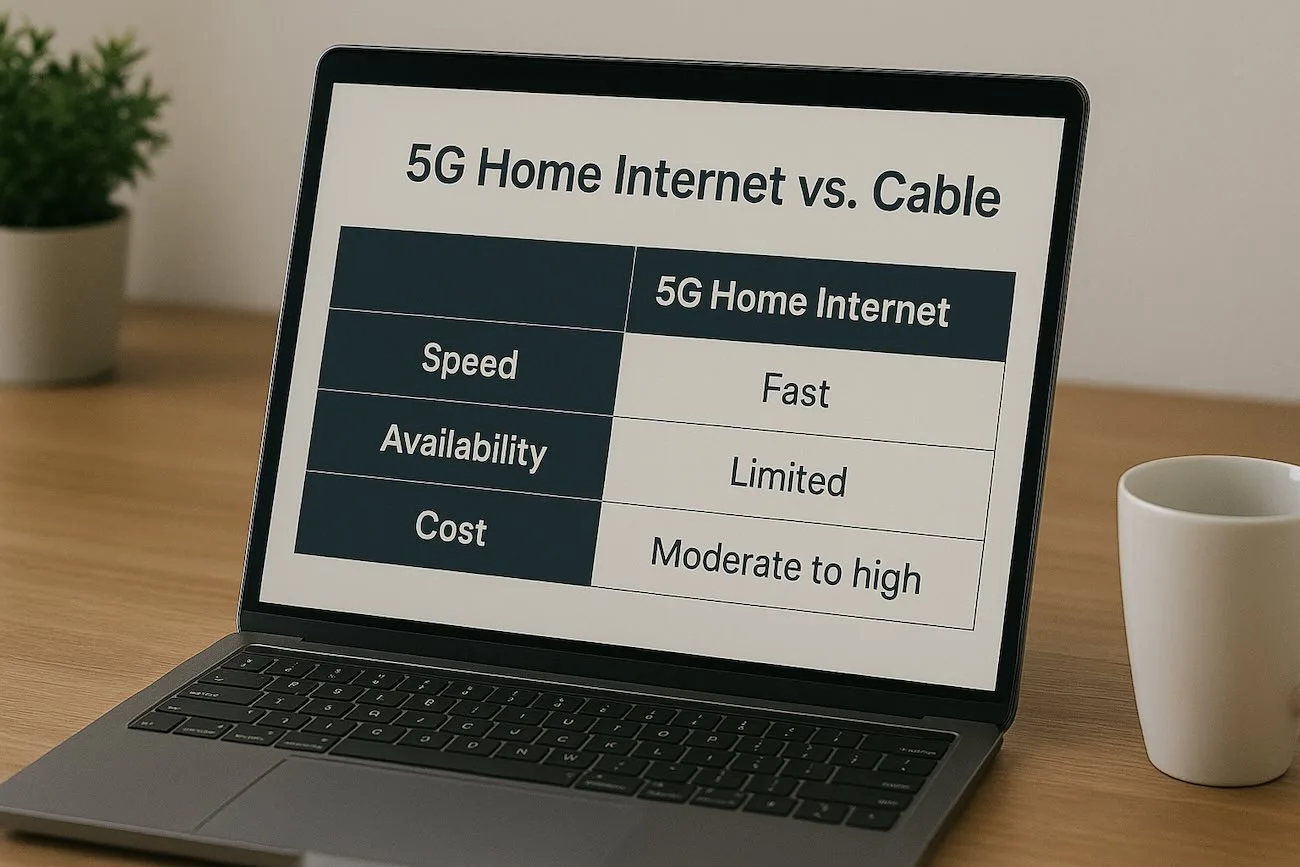
| Feature | 5G Home Internet | Cable Internet |
|---|---|---|
| Monthly Price | $35-70 (locked in) | $40-100 (increases after promo) |
| Speed Range | 85-500 Mbps typical | 300-2,000 Mbps |
| Speed Consistency | Variable (depends on tower distance, weather) | Very consistent (wired = stable) |
| Setup Time | 5-10 minutes (plug in and go) | 1-4 hours (technician visit usually required) |
| Equipment Fees | $0 (included free) | $10-15/mo rental or buy your own |
| Installation Cost | $0 (self-install) | $0-100 (professional install) |
| Contracts | None (cancel anytime) | Often 1-2 year contracts |
| Data Caps | Unlimited | Usually unlimited, some have 1.2TB cap |
| Upload Speeds | 12-55 Mbps | 10-35 Mbps (500 Mbps+ on fiber-backed) |
| Latency (Ping) | 20-40 ms | 10-25 ms |
| Weather Impact | Can affect speeds during storms | Minimal (underground cables) |
| Availability | Growing (40+ million homes) | Widespread (140+ million homes) |
| Price Increases | Locked for 3-5 years | $20-40 increase after year 1 |
| Best For | Budget users, renters, easy setup | Heavy users, gamers, large households |
Let’s Talk About Actual Speed: What You’ll Really Get
Here’s where things get interesting. Cable companies love to advertise “up to 2,000 Mbps!” but in reality, most people get pretty close to what they’re promised. If you pay for 500 Mbps, you’ll typically see 450-550 Mbps on a speed test.
5G is a bit more… let’s say “adventurous.” T-Mobile says you’ll get 134-415 Mbps, and they’re being honest about the range because it really depends on where you live. If you’re half a mile from a 5G tower with clear line of sight? You might hit 500+ Mbps. But if there are buildings, trees, or you’re a few miles away? You might see 100-200 Mbps.
Real-World Speed Check:
During our testing, T-Mobile consistently delivered 350-400 Mbps in suburban areas with good coverage. Verizon’s Ultimate plan hit 600+ Mbps in urban zones. Cable (Xfinity 500 Mbps plan) stayed rock-solid at 480-510 Mbps regardless of weather or time of day.
What Do You Actually Need?
- Streaming Netflix/YouTube: 25 Mbps is plenty, even for 4K
- Zoom calls: 10-20 Mbps per person
- Gaming: 50+ Mbps (latency matters more than speed)
- Large household (5+ devices): 200-500 Mbps
- Downloading huge files/4K streaming on multiple TVs: 500+ Mbps
The truth? For most households, both 5G and cable provide more than enough speed. The bigger question is about consistency and reliability.
5G Home Internet: The Good, The Bad, and The “It Depends”
What’s Great About 5G
- Ridiculously easy setup: Seriously, plug it in, wait 2 minutes, you’re online
- Honest pricing: $50/mo means $50/mo, not “$50/mo for 12 months then $85/mo”
- No technician visits: No 4-hour appointment windows where nobody shows up
- Perfect for renters: Take it with you when you move (same account!)
- No equipment fees: Router included, no $15/mo rental nonsense
- Unlimited data: Stream, download, game—no caps
- No contracts: Cancel any month if it’s not working out
What’s Great About 5G
- Speed varies by location: Your neighbor might get 400 Mbps, you might get 150
- Weather can matter: Heavy storms might slow things down temporarily
- Tower distance is critical: Too far = slower speeds, period
- Obstructions affect signal: Buildings, trees, hills can block signal
- Network congestion: Busy times might see slowdowns (though rare)
- Not great for serious gaming: Higher latency than cable (20-40ms vs 10-20ms)
- Limited availability: Not everywhere yet (but expanding fast)
Before You Sign Up for 5G:
Most providers offer a trial period (T-Mobile has 15 days, Verizon offers 30 days). USE IT. Test the speeds at different times of day. If you’re not getting at least 100+ Mbps consistently, it might not be worth it for your location.
Cable Internet: Old School But Still Solid
Why Cable Still Dominates
- Ultra-reliable: 99.9% uptime, works in any weather
- Faster maximum speeds: Up to 2,000 Mbps if you need it
- Better for gaming: Lower latency (10-20ms) = less lag
- Consistent speeds: Get what you pay for, every time
- Widely available: Pretty much anywhere there are homes
- Higher upload speeds: Better for video calls, uploading files
- Proven technology: It just works, no surprises
The Annoying Parts of Cable
- Price games: “$50/mo” turns into $75 after year one
- Equipment fees: $10-15/mo to rent a modem (or buy your own for $100+)
- Installation hassles: Wait for a technician, 4-hour window, might reschedule
- Contracts sometimes required: Early termination fees if you cancel
- Customer service reputation: Cable companies aren’t exactly loved
- Promotional pricing tricks: Have to call yearly to negotiate better rates
- Hidden fees: “Broadcast TV fee,” “regional sports fee,” taxes, etc.
Pro Tip for Cable:
When your promotional rate expires, call and say you’re thinking of switching to 5G home internet. Cable companies are terrified of losing customers to wireless and will often extend your promo rate or offer a better deal. Works 80% of the time!
The Real Cost Over Time: Let’s Do the Math
Here’s where 5G really shines. Let’s compare what you’ll actually pay over 3 years:
5G Home Internet (T-Mobile)
- Year 1: $50/mo × 12 = $600
- Year 2: $50/mo × 12 = $600
- Year 3: $50/mo × 12 = $600
- Total: $1,800
- Equipment: $0
- Installation: $0
- Grand Total: $1,800
Cable Internet (Xfinity 500 Mbps)
- Year 1: $55/mo × 12 = $660
- Year 2: $80/mo × 12 = $960 (price increase!)
- Year 3: $80/mo × 12 = $960
- Total: $2,580
- Equipment rental: $14/mo × 36 = $504
- Installation: $100
- Grand Total: $3,184
The Difference:
You’d save $1,384 over 3 years with 5G. That’s enough for a nice vacation, a new laptop, or 27 months of Netflix Premium. Just saying.
Which Should YOU Choose? Decision Time
Choose 5G Home Internet If:
- You live within 1-2 miles of a 5G tower (check provider coverage maps)
- You’re on a budget and hate price increases
- You’re renting and might move soon
- You don’t game competitively (casual gaming is fine)
- You have 1-4 people in the house
- You value simple, transparent pricing
- You want to try it risk-free (use the trial period!)
Choose Cable Internet If:
- You need rock-solid reliability for work-from-home
- You’re a serious gamer (latency matters)
- You have 5+ people using internet simultaneously
- You regularly upload large files (cable has better upload speeds)
- You live in a rural area with weak 5G coverage
- You need the fastest possible speeds (1 Gbps+)
- You’re willing to negotiate prices every year for best rates
Hybrid Solution:
Some people are using 5G as their main internet and keeping a basic cable plan ($30-40/mo) as backup. Not a bad idea if your job depends on being online 24/7. Expensive? Yes. But two connections means you’re never offline.
Our Verdict
For most people, 5G home internet is the smarter choice. The savings are real, setup is painless, and speeds are good enough for typical household use. BUT—and this is important—you need to test it first using the trial period. If speeds are consistently 150+ Mbps, you’re golden.
Cable still wins for heavy users, gamers, and anyone who needs guaranteed reliability. It costs more, but you get what you pay for: consistent speeds and rock-solid uptime.
The good news? You can’t really go wrong. Both options are way better than the DSL or satellite internet people dealt with 10 years ago!
Frequently Asked Questions
Yes, absolutely! Netflix recommends 25 Mbps for 4K streaming. Even on the lower end, 5G delivers 100+ Mbps, which is plenty for multiple 4K streams. You could run 10+ Netflix streams in 4K simultaneously and still have bandwidth left over.
For casual gaming, yes—it works fine. The speeds are there (100+ Mbps is plenty). The catch is latency: 5G averages 20-40ms ping, while cable is 10-20ms. For competitive gaming (esports, ranked matches), that extra 15-20ms can matter. For everything else? You won’t notice the difference.
It’s their business model. They lure you in with promotional pricing ($50/mo), then after 12 months it jumps to the “regular” rate ($75-85/mo). It’s annoying, but you can usually call and negotiate a better rate. 5G providers don’t do this—your price is locked for 3-5 years.
Most providers offer trial periods: T-Mobile gives you 15 days, Verizon offers 30 days. If speeds aren’t good enough, you can return the equipment and get a full refund. No risk, which is why we always recommend trying 5G first before committing to cable.
Not really. 5G providers give you a gateway device that connects to the cellular network—it’s not like cable where you can just plug in any modem. The good news? The gateway is free, includes Wi-Fi, and usually works great. With cable, you CAN use your own modem ($100-150 one-time cost) to avoid rental fees.
Heavy rain or storms can slow down 5G speeds temporarily, but it’s not as dramatic as you might think. You might drop from 300 Mbps to 200 Mbps during a downpour. Cable is underground, so weather doesn’t affect it at all. In most cases, the impact is minor and temporary.
Ideally within 1-2 miles with relatively clear line of sight. Check the provider’s coverage map and read reviews from people in your neighborhood. If you’re 3+ miles away or there are lots of buildings/trees blocking the path, you might get slower speeds. That’s why the trial period is crucial—test it yourself!
Yes! Both T-Mobile and Verizon offer $15/mo discounts if you bundle home internet with a mobile phone plan. T-Mobile’s bundle can drop to $35/mo, Verizon’s to $35/mo as well. If you’re already a customer of either carrier, this is a no-brainer savings opportunity.
Nope! Both T-Mobile and Verizon offer unlimited data with no caps. Stream, download, and use as much as you want. Some plans mention “deprioritization” after 1.2TB/month during peak hours, but that rarely affects actual usage. Cable usually has no caps either, though some providers have 1.2TB limits.
Yes! That’s one of the coolest features. With 5G, you literally unplug the gateway, take it to your new place, plug it back in, and you’re online (assuming they have coverage there). With cable, you have to schedule installation, possibly pay fees, and sometimes face delays. This makes 5G perfect for renters.
Disclaimer: Last updated November 2025 Prices and speeds are based on current provider offerings and may vary by location. Always check availability and pricing in your area. We’re not affiliated with any providers mentioned—just helping you make an informed choice!